Tuesday, August 7, 2018

Evolution of a classic: the Britains 12-pounder Napoleon

Family tree

W. Britain has been making and marketing American Civil War cannons since 1951.  Over the last dozen years I have acquired the progression of the Britain's 12-pounder light gun howitzer - "Napoleon"- in its various incarnations over nearly seven decades.

I have always been a fan of Civil War artillery, especially the Napoleon, and in my role as a ranger for the National Park Service I have often been in very close proximity to that gun, and have become fairly intimate with it's design and operation.


The firing of the 12-pounder light-gun howitzer (Napoleon) at Artillery Weekend at Antietam National Battlefield.

So onward then, through the years with walk-arounds of four incarnations of this magnificent gun.


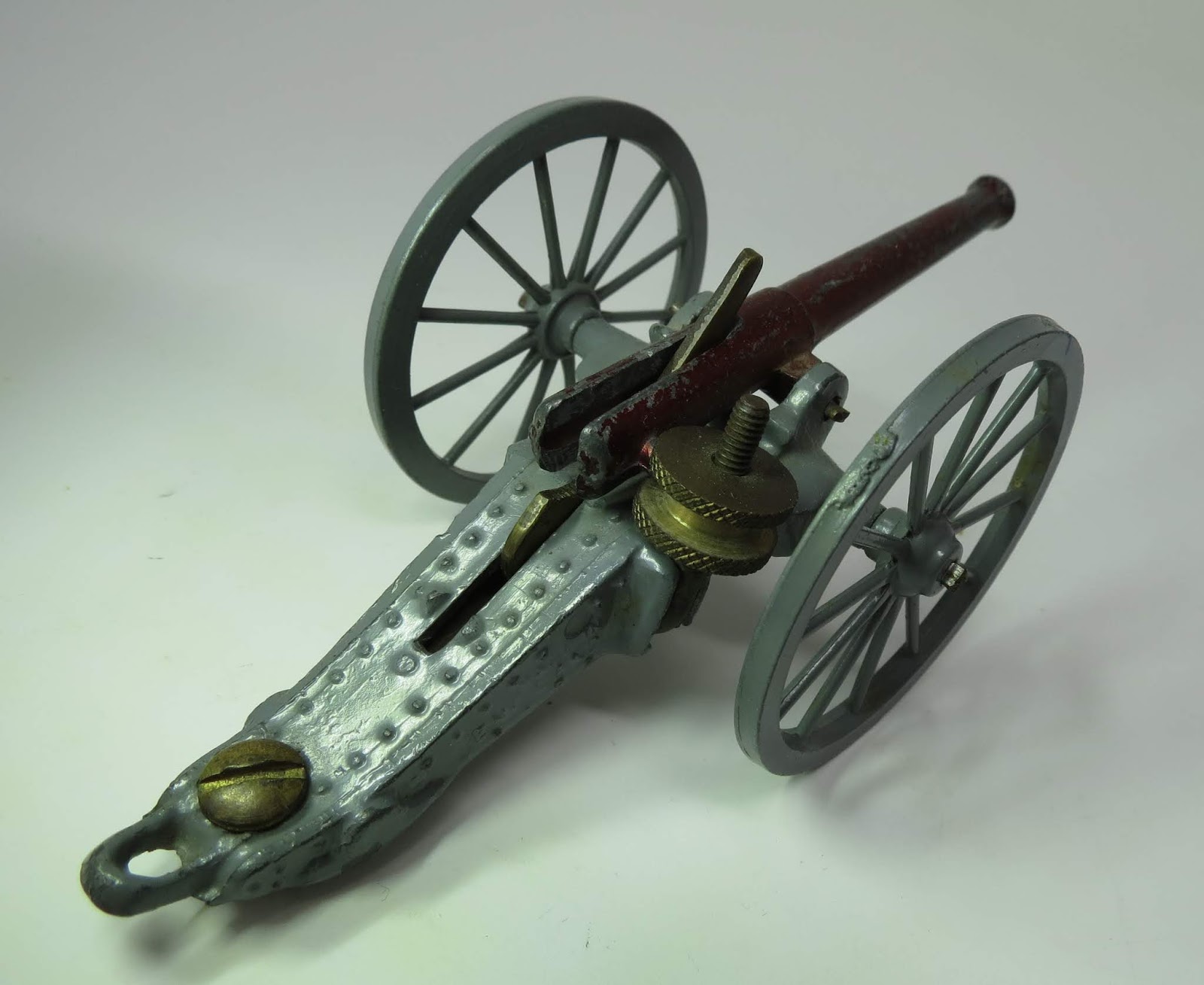
W. Britain #2057, 2058, 1951


This gun was originally introduced in the 1930s as a British fieldpiece but it was reintroduced in 1951 (a year before my birth) as numbers 2057 and 2098.  The accounting for the two numbers is that it came in two versions, one with a Confederate crew and the other Union.


Although not expressly a Napoleon, and quite generic actually, nonetheless for the purposes of this family tree I am including it.

It is a very handsome gun though its similarity to an actual ACW gun is a little questionable in some respects.

For one thing the barrel is overly long for a Napoleon and rather diminutive in girth.


Another divergence for the actual American gun is the very wide, stout trail...

as well as the prominent rivets along its length.


It has a simple spring-loaded firing mechanism, with a robust threaded-post and wheel, in brass, to elevate or depress the angle of fire.

The size of the elevating wheel rather overwhelms the lines of the gun, and puts me in the mind of a desk cigarette lighter.  Care for a smoke?

Altogether an nice gun, but it bears only a passing resemblance to the Napoleon...any old port in a storm for a kid playing Civil War in the late fifties and early sixties I guess.  In fact this may have been the go-to gun for the bedroom floor battles of the 1961-65 Civil War centennial era.


W. Britain "Deetail" 7464, 1966

And speaking of the centennial... W. Britain was, unfortunately, a day late and a dollar short for that national observance; not issuing it's Deetail (or Eyes Right, I'm not sure, maybe a reader can leave a comment) Napoleon in 1966.

This impressive model was boxed individually as #8726, or as it's usually seen, as part of set 7564 - the four-horse gun and limber team.


The wheels are slightly oversized and the barrel is equally undersized, but the carriage and many of the details are pretty faithful to and actual 12-pounder.


The stance of this gun is quite out-of-scale...much wider than the actual gun.


Elevation and depression of the barrel is achieved through turning the geared crank, and although I've not fired this one, the upward projecting lever is the spring-loaded firing trigger.

I'm sorry that I didn't have this one as a child, but realistically, it was priced beyond my parent's reach and never appeared under my Christmas tree (must be why I'm over-compensating now!).


W. Britain #17227, 2002

Now we're getting serious!

The Union six-horse limber and gun combination (#17379) came out in 2002 and it was a quantum leap in accuracy and detail.  It also marked the transition from "toy" to "miniature" in Britain's artillery.

This is a really beautiful piece in nearly all respects.

Britain's attention to detail included realistically painted the iron tyres of the wheels a nice rusty color, denoting field use.

The gun tube is quite superb and really captures the true dimensions and color of the bronze barrel - which was always burnished bright by Civil War batterymen.


My complaints are very few about this gun.  One is the overly robust trail.  The actual trail on a 12-pounder is not this wide.

Similarly, the wood grain detail, though nice, is not representative of the smoothly-planed white oak that comprised an actual trail .


On this version the tube is slightly depressed as it comes towed behind the limber when on display.


Unlike its progenitors, this gun has the rope prolonge in place.

It also has a detailed elevation screw and two sponge rammers, though one should actually be replaced by the corkscrew-like "worm".

In all respects, a really beautiful gun; and though no longer marketed as a "toy" it has still seen plenty of action on my toy soldier table and has sent many a plastic soldier to his celestial reward.


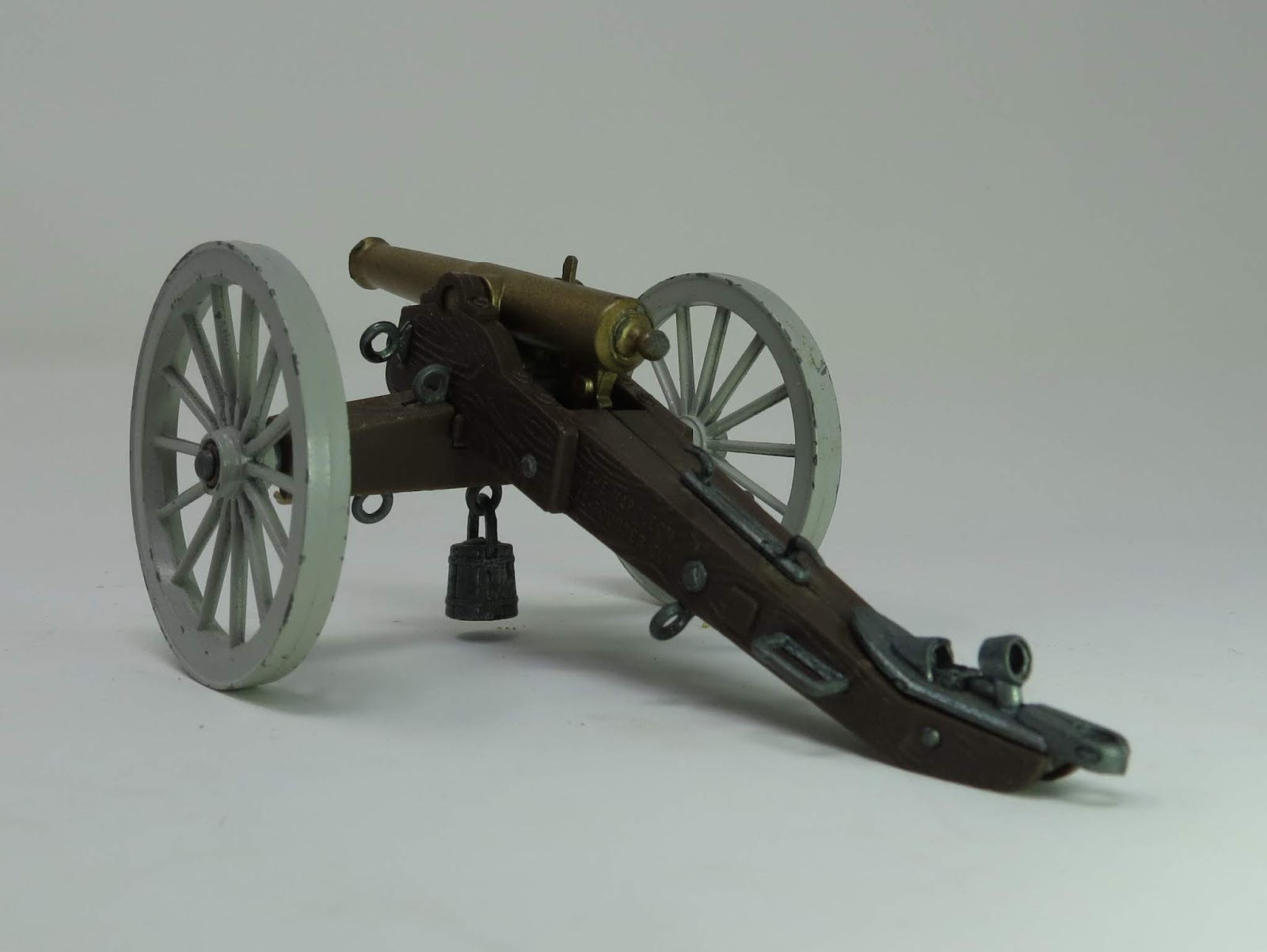
W. Britain #31066, 2010

Here then, is the apex...so far.

This is the fourth-generation Britain's Napoleon introduced in 2010, and it's exquisite.


This gun comes with the trail spike (or "hand spike") deployed.

Each gun carried two hand spikes stowed on each cheek of the gun.  This long lever provided enough leverage for a single man to deflect the gun to the left or right.


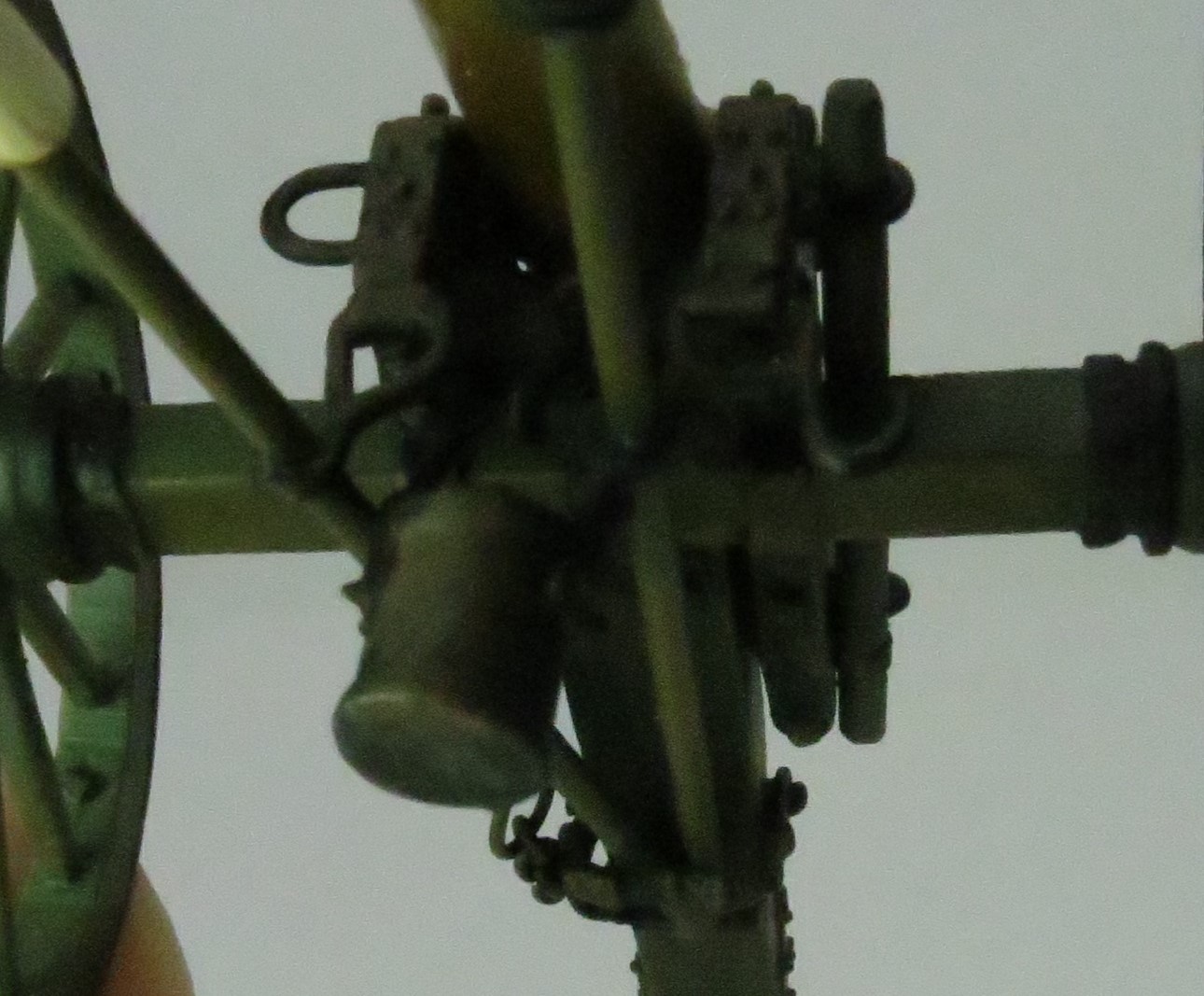
In this rear-view you can just see the second spike on the left cheek of the gun.  Also in this view you can see my one criticism of this gun, and that is the width of the trail; unlike its overly-wide predecessor, this trail is now too narrow compared to the real thing.


The elevating screw is wonderfully cast, to the point where it actually looks functional.

The front blade sight is cast to perfect scale.

The tube detail is outstanding with knob, vent, and the bracket from which the pendulum-hausse rear sight was suspended.

The hooks and rings for implement stowage are beautifully cast, as is the water bucket.

The trails tell the tales.  This seems to be the universal weakpoint for each of these guns.  Either too wide, too narrow, or too short, W. Britain hasn't quite gotten it right.  Perhaps in its next reincarnation W. Britain will achieve the perfection that the actual gun deserves.


My affinity for the twelve-pounder began as an eight-year-old enthralled with the Civil War and continues through to what I do for a living today.  I'm a lucky guy.


Keep me in your sights until next time.

Soldier on!

Mannie

p.s.
Please do leave comment, and especially corrections.

Origins story

Ten years old, home with a cold, with a good book and a tabletop battle.


Soldier on!

Mannie

Tuesday, July 24, 2018

The toy soldier studio - Summer 2018


Many years ago I visited Greenfield Village in Dearborn Michigan.  The Village, a crazy-remarkable and odd place, the brainchild of Henry Ford, is an eclectic collection of not quite a hundred historic buildings spanning 300 years of American history.  All of them are in the context of a small town, laid out on streets, avenues, and alleys; there is even a steam-powered riverboat and locomotive that take visitors around the village.  I can only compare it to "Mainstreet USA" at Disneyland, with the exception that all of the buildings are real and genuinely historic.  


Ford spared no expense in locating, buying, and transporting entire buildings to the village; and the buildings are remarkable;  An Illinois courthouse where a young Abraham Lincoln practiced law, the Wright brothers home and workshop, the building in which Henry Ford assembled his first automobile, the home of Stephen Foster, and the entire complex of Thomas Edison's Menlo Park laboratories and workshops.  

My favorite building is tiny, unassuming, and definitely cute; it is the garden office of Luther Burbank (look it up on Google).  It is an utterly charming little building...less a house and more an ornate, small, outbuilding, that is appointed in the manner of a typical office of the era.  I was nearly enthralled with it; and I really coveted it.

Jump ahead to 2006 when I bought my charming little house here in Boonsboro.  In the back yard was a small, unassuming shed, that captured my imagination even before the ink was dry on the mortgage.


It was a commercially made shed with nice windows, a steel door and a tight roof.  Although the previous owner had removed most of a wall with a sawz-all to accommodate his motorcycles.

The inside was bare studs, festooned with spider webs and dead bugs.

I covered the opened wall, and let my plans percolate while I attended to other homeowner things.

Finally in 2009, I found myself with time on my hands and a hankering for a big project.  With hammer and a pocket full of nails (and a complete woodshop) and the memory of Burbank's field office I began my work.

The first thing I did was to replace the missing wall, and run electricity to it.

I't been an ongoing project over the years, making little improvements and fine-tuning all along the way, and here in the summer of 2018, except for some painting...I think it's done.

And here it is, the Toy Soldiers Forever! toy soldier studio.


The most recent additions were the shutters and geraniums.

Door guards include a hessian flanked by two, large, cast-iron cannons.


Please accept my invitation to come in and take a look.


Carpet, wallboard, paint, tracklights, and wainscoting, got it looking very civilized.  Then came bookcases (salvaged from a Border's Bookstore remodel) and a diorama table at the far end.


I finally found a permanent home for the Frederick Ray Civil War soldier prints that I've had since my 1962 trip to Gettysburg as a nine-year-old.

Continuing the nine-year-old boy theme includes a collection of nearly all of the Scott-Forseman readers that got me through kindergarten (Dick, Jane, Sally, Spot, and Puff) to eighth grade at my rural three-room school house in Burt Michigan.


The diorama table has seen a lot of action.


The studio also made space for my skull collection.

Replica Civil War small-arms crates that I make in my shop...

are chock-full of toy soldiers (mostly plastics).


I think I captured some of the spirit of Luther Burbank's office in that this is a particularly cozy place to read, listen to the radio, and - of course - play with toy soldiers.


Thank you Luther Burbank for the inspiration, and a wonderful place to...

Soldier on!

Mannie


Sunday, July 15, 2018

W. Britain Limber and two-man crew #17431


Happy is the boy who gets that distinctive scarlet and gold box in the mail that epitomizes excellence in toy soldiery.  I purchased, from the fine folks at Crown Military Miniatures, the W. Britain set 17431, two-man limber and crew from 2003.


(the same scene in 1:1 scale at Antietam National Battlefield's Artillery Weekend)

It's a peach of a set and just the sort of thing I'm looking for my next big series of scenarios focusing on Battery B 4th US Artillery at Antietam.

The project is slowly but surely coming together, I'm assembling guns, horses, limbers, caissons and artillerymen to tell the story of Battery B on the morning of September 17th, 1862 when fate reunited them with their former commander - General John Gibbon.

For the next few weeks I'll be painting artillerymen, many of which are conversions.  For unique poses I looked outward toward W. Britain (the maker of all my guns) for some really great artillerymen.  This two-man limber set is very much a welcome addition to the battery.

My six horse-drawn limbers for the battery are the classic Britain's Deetail models from the late sixties, some of which I've featured in earlier battle scenarios (go here).


Those venerable Deetail limbers compared to the metal 2003 version demonstrate the difference between "toys" and "miniatures"....though please note, on my table everything, no matter how upscale, is a toy meant for playing with.  I'm very happy to find that there's a whole lot of nine-year-old left in me.


The detail is wonderful, including the Table of Fire for a Napoleon affixed to the inside of the limber lid, in the regulation manner.


These guys are from the 2003 generation of W. Britian's figures.
The attention to detail has come a very long way in the past fifteen years.


2003


Compared to the 2016 figures the 2003 guys look cartoonish.


The scenario presented by this three-piece set is a welcome one on the table top battlefield.  With the limber lid raised and the projectiles visible, the limber man is passing a ball into the gunner's haversack to be taken up to the waiting gun.


A disapproving Dunker (Anabaptist) Mrs. Mumma looks on skeptically.


I have advance-ordered the yet to be released 2018 Britian's three piece limber kit, and the photos on the W. Britain website demonstrate again that the detail in the intervening fifteen years has improved exponentially.

I'm watching my mailbox, and will post an entry when it finally shows up, which may not be for a while yet.


Really nice model, and really nice people at Crown Military Miniatures.

Soldier on!

Mannie